There are six checks you can do at home in ten minutes: skin colour and texture, coat and comb test, ears, paws and pads, the friction zones under the legs and collar, and a nose-to-tail run of your hands feeling for lumps, heat and damp. Done weekly, these catch most problems while they are still small.
Almost every skin condition that ends up at the vet was visible at home first. Not obvious, but visible. The reason it gets missed is that owners look at the coat rather than under it, and the coat is exactly what hides the early stage of everything.
None of this requires equipment beyond a comb, decent light and your hands. It also does not replace a vet. What it does is change the question from "has something gone wrong" to "has anything changed since last week", which is a much easier question to answer.
Below is the full routine, what each finding usually means, and the specific signs that should send you to a vet rather than back to the brush.
Why Home Checks Matter
Skin is the largest organ an animal has, and it reacts to almost everything: parasites, allergies, diet, stress, hormones, humidity and the products you put on it. That makes it an unusually good early warning system, provided somebody is reading it.
The practical problem is coverage. A groomer sees your dog every six to eight weeks, a vet perhaps once a year. Both are looking at a snapshot. You see the animal every day, which means you are the only one positioned to notice a gradual change.
Weekly checks also make the animal easier to handle. A dog used to having its paws, ears and belly touched calmly is a dog that will tolerate the vet, the groomer and an emergency. That habit is worth as much as the findings.
The Six Checks
1. Skin colour and texture
Part the coat in four places: shoulder, mid back, flank and base of tail. Healthy skin is pale and smooth, or evenly pigmented if your animal has dark skin. Look for redness, flaking, scabs, greasy patches, black specks, or a change in pigment. Feel for heat, which is often the first sign of inflammation. If flaking keeps turning up in the same spots, the usual causes are set out in Dog Dandruff: What Causes White Flakes and How to Fix It.
2. Coat and comb test
Place a steel comb flat against the skin and pull outward. It should run clean to the tip. If it catches, the coat is felting below the surface. Do this behind the ears, under the front legs and on the back of the thighs, which fail first on every coat type.
3. Ears
Lift the flap and look. Clean ears are pale, dry and almost odourless. Brown or black discharge, a yeasty smell, redness or head shaking are all worth a vet appointment rather than a home clean.
4. Paws and pads
Check between every toe. Look for redness, splits in the pads, matted hair between the pads, and anything embedded. Brown staining on the fur between the toes usually means the animal has been licking, and licking means something is uncomfortable.
5. Friction zones
Anywhere something rubs. Under the collar, under a harness, the armpits, the groin, and where a dog's legs meet the body. These are where mats and rubs start, and they are the areas most often skipped because they are awkward to reach.
6. Nose to tail run
Both hands, slow, over the whole body. You are feeling for lumps, swellings, warm patches, damp spots and anything that makes the animal flinch. Note where anything is so you can tell next week whether it has changed.
What Common Findings Usually Mean
- White flakes: Dry skin, often from indoor heating, over-bathing or a harsh shampoo. Persistent flaking with itching needs a vet.
- Black specks that turn red when wet: Flea dirt. Treat the animal and the house.
- Greasy coat with a smell: Often yeast, particularly in skin folds, ears and between toes.
- Red skin under a mat: The mat is pulling. Do not brush it out, cut the tension or see a groomer.
- Hot spot, a wet inflamed patch: Fast moving and painful. Vet, not home care.
- Thinning on both sides equally: Symmetrical loss points to something systemic. Book an appointment.
- Brown staining on paws: Saliva from licking. Look for the reason rather than cleaning the stain.
If the comb keeps catching in the same place week after week, the technique in mat prevention tips for dogs covers how to clear the layer that is causing it.
Recommended Tools for Home Skin Checks
Home checks need a brush that opens the coat so you can actually see the skin, and a comb that tells you what the brush missed. That is the whole kit.
A gentle conditioning shampoo covers the other half of the job, since a large share of what you will find at the skin comes down to dryness.

Flying Pawfect Slicker Brush
You cannot inspect skin through a closed coat, and on anything thicker than a smooth-coated breed your fingers alone will not open it far enough. The slicker brush is what makes the skin visible.
The fine stainless steel pins slide between guard hairs and lift the layer underneath, so the coat parts cleanly rather than being pushed aside. On a dense double coat that is the difference between seeing the skin and guessing at it.
The cushion pad flexes under pressure, which matters more here than in ordinary grooming, because you may be passing over skin that is already sore. Pins that give way when they meet resistance do not turn a check into an injury.
Doing the check with a brush in hand also means you are treating as you inspect. Brushing spreads skin oil along the hair, which is the most effective thing you can do for a dull coat and costs nothing extra.
Work in sections. Part the coat with your free hand, brush the exposed layer, look at the skin, then move the parting an inch and repeat. That rhythm is the check.
Spend the most time on the areas the routine above flags: behind the ears, under the front legs, the groin, and the base of the tail. Those four places account for most of what home checks find.
- Best for: Weekly skin and coat inspections, double coats, curly coats, long-haired cats and daily maintenance.
- Why it works: It opens the coat to the skin without scraping, so you can see what is actually going on underneath.
- Context: Brush the section, look at the skin, comb-check, move on.

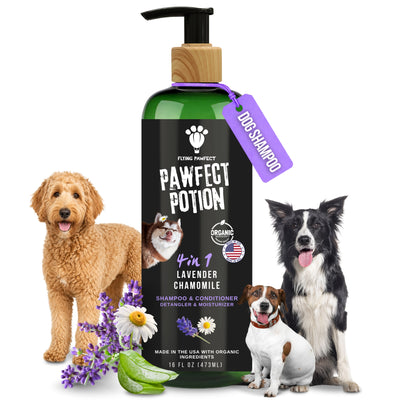
Pawfect Potion 4-in-1 Shampoo
A surprising share of what home checks turn up is simply dry skin, and the most common cause of dry skin in an otherwise healthy animal is a shampoo that strips more than it should.
This one cleans, conditions, detangles and moisturises in a single pass. It is pH balanced for dogs and uses plant-derived cleansers from coconut, with organic aloe vera and coconut oil, plus lavender and chamomile for a calmer bath.
Because it conditions as it cleans, the skin keeps more of its own oil, and the difference usually shows in the next weekly check as less flaking and less scratching.
Brush and comb-check before the bath, never after. Water tightens a loose tangle into a solid mat, and a mat over irritated skin is the worst combination you can create.
Dry all the way to the skin, particularly in the armpits, groin and any skin fold. Damp skin in a covered area is where yeast and odour problems start.
- Best for: Dry or flaky skin, sensitive skin, and routine washes between grooming appointments.
- Why it works: Cleans without stripping and conditions in the same step, so the skin barrier stays intact.
- Context: Brush first, bath second, dry thoroughly, brush again.
Step by Step: The Ten Minute Weekly Check
- Step 1. Choose a fixed day and a quiet spot with good light. Consistency is what makes changes visible.
- Step 2. Run both hands nose to tail, with the grain then against it.
- Step 3. Part and inspect the skin at shoulder, mid back, flank and tail base.
- Step 4. Comb-check behind the ears, under the front legs and the back of the thighs.
- Step 5. Check ears, then each paw and between every toe.
- Step 6. Check under the collar and harness lines.
- Step 7. Write down anything you found and where. Next week's check is only useful if you can compare.
When to Stop and Call Someone
Some findings are not a grooming problem. Go to a vet for open or weeping skin, a rapidly spreading red patch, swelling, a lump that was not there last week, ear discharge with a smell, limping, or any area the animal will not let you touch.
Go to a groomer for mats that are tight against the skin, matting across a large area, or a coat so felted that a comb will not enter it. Forcing a brush through those causes brush burn and pain, and the point at which to stop is covered in when you should stop brushing and call a groomer.
Common Mistakes During a Skin Check
Checking the coat instead of the skin. Everything starts at skin level. If you have not parted the coat, you have not checked.
Only checking when something seems wrong. The value is in the baseline. Without a normal to compare to, a finding tells you very little.
Skipping the awkward areas. Armpits, groin and between the toes are where problems concentrate, precisely because they are hard to reach and easy to skip.
Treating findings with products before understanding them. A spray over a hot spot delays the vet visit that would have fixed it in three days.
Cleaning ears routinely. Over-cleaning irritates the canal. Look weekly, clean only when needed and when a vet has said the ear is healthy enough to clean.
Not writing anything down. A lump you noticed a month ago is only useful information if you can say whether it has grown.
FAQs
How often should I do a full check?
Once a week for most animals, and after every walk in long grass during summer for the paws and coat. Quick hands-on checks can happen every time you brush.
My dog will not let me touch its paws. What now?
Build up slowly with short, calm sessions and something the dog likes at the end. Start by touching a leg for a second and stopping before the dog objects, then extend over weeks.
Is it normal for skin to be pink?
Pale pink is normal on unpigmented skin. Bright red, blotchy or hot is not. Compare against another area of the same animal rather than against another dog.
What does flea dirt look like?
Small black specks in the coat, most often at the tail base. Put some on damp white paper and it will spread a red-brown stain, because it is digested blood.
Should I clean my dog's ears every week?
Look every week, clean only when there is something to clean and after a vet has confirmed the ear is intact. Routine cleaning of a healthy ear does more harm than good.
Can I do these checks on a cat?
Yes, in shorter sessions. Cats tolerate less handling at once, so split the routine across two or three days rather than trying to do everything in one sitting.
My dog has a small lump. Is that urgent?
Not necessarily, but it should be looked at rather than watched indefinitely. Note the size and location so the vet has something to compare against.
How do I tell dry skin from an allergy?
Dry skin flakes and improves with conditioning. Allergy tends to come with itching, licking, ear trouble and often paw chewing, and it does not improve with a change of shampoo alone.
Final Thoughts
Ten minutes a week, on the same day, with your hands and a comb. That is the entire routine, and it is the single most useful health habit an owner can build.
You are not trying to diagnose anything. You are trying to notice change early enough that whoever does the diagnosing has an easy job.
![[CL] Flying Pawfect coral large flat slicker brush for dogs](http://flyingpawfect.com/cdn/shop/files/CoralLarge2026.jpg?v=1783693245&width=400)
![[BL] Flying Pawfect baby blue large curved slicker brush for doodles and long haired dogs](http://flyingpawfect.com/cdn/shop/files/CBL_HERO_26_05_819be2a4-36dd-43dc-bda3-1730fa9e5818.jpg?v=1784475444&width=400)